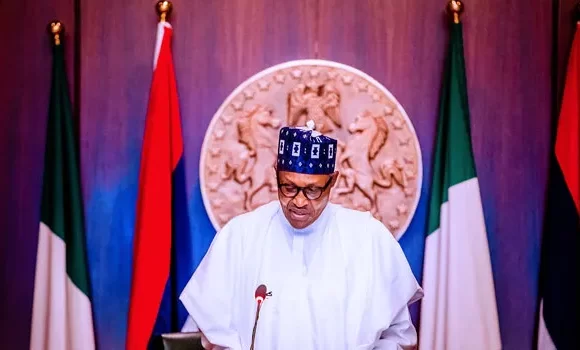
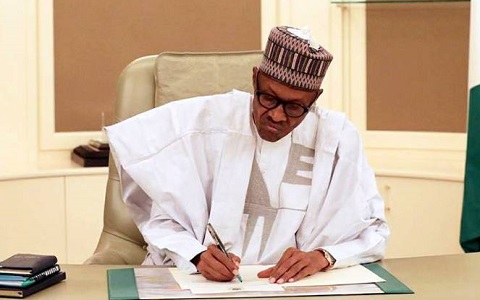
President Muhammadu Buhari recently signed into lawthe Nigerian Correctional Service Bill.
The act changes the name of the Nigerian Prisons Service, NPS, to Nigerian Correctional Service.
Senior Special Assistant on National Assembly Matters, Senator Ita Enang noted that the Nigeria Correctional Service is made up of two faculties, the custodial and non-custodial service.
The non-custodial service was intended to be a place of reformation and that the person sentenced under this will not stay in custody but will have remediation.
The presidential aide noted that the non-custodial faculty of the correctional service is responsible for the administration of non-custodial measures, in form of community service, probation, parole, restorative justice measures and such other measures as a court of competent jurisdiction may order.
He disclosed that the restorative justice measure approved in the act includes victim-offender mediation, family group conferencing, community mediation and other conciliatory measures as may be deemed necessary pretrial, trial during imprisonment or even post-imprisonment stages.
The bill was first presented and read in the senate in January 2008 by a former senator and current chairman of the Niger Delta Development Commission, NDDC, Victor Ndoma-Egba, in the sixth assembly.
Mr. Ndoma-Egba said the bill was aimed at addressing fundamental lapses inherent in the Prisons Act and a review of the act was necessary to put in place a framework for the rehabilitation and transformation of inmates and address the issue of inadequate funding of prisons.
The act is expected to reduce congestion of prisons across the nation.
Though, some analysts have described the move as putting the “cart before the horse” saying the bill on the total reform of the Nigerian Prison, which would see to proper reorganisation and rearrangement should have been signed.
They emphasised that the present state of prisons all over the country urgently requires quick intervention and attention from the government beyond change in name.
On the whole, it must be emphasised that the neglect on the part of government, coupled with high level corruption among prison officials have rendered prisons across the country ineffective to correct social vices and to a large extent constitute serious danger to the society.
Instead of rehabilitating offenders and reintegrating them into the society for better living the reverse is the case.
It is imperative therefore that the federal government set up a virile committee, which should comprise of professionals and experts who understand modern prison arrangement.
Also, urgent infrastructural intervention is needed in all the prison across the country for the purpose of de-congestion, and provision of comprehensive vocational programmes to empower inmates and prepare them for life after prison should be prioritised.
Most importantly, social engagement in the area of skills acquisition and robust reorientation programmes would go a long way to reintegrate inmates back into the society.
Titilayo Kupoliyi