By Maxwell Oyekunle
Winning the FIFA World Cup at a young age is a remarkable achievement, but the youngest players to lift the trophy did not all make the same contribution to their teams’ success.
While some became decisive figures in their countries’ triumphs, others were promising youngsters who earned a place in a victorious squad without playing a major role in the tournament.
From Brazil legend Pelé, who became the youngest World Cup winner at 17, to France’s Kylian Mbappé, who scored in the 2018 final, the list offers a fascinating look at the relationship between age, opportunity and impact on football’s biggest stage.
1. Pelé — Brazil, 17 years, 249 days — 1958
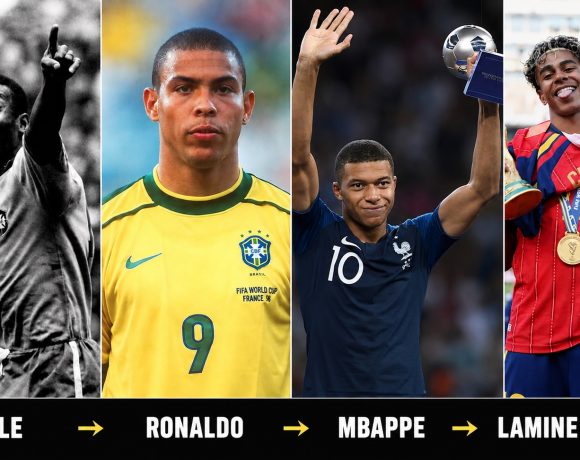
Pelé remains the youngest player to win the World Cup. He was not merely a squad member. The 17-year-old became one of Brazil’s most important players during the tournament, scoring six goals, including two in the final against Sweden.
His performance established him as a global football sensation and remains the benchmark for teenage impact at a World Cup.
2. Ronaldo Nazário — Brazil, 17 years, 298 days — 1994
Ronaldo was part of Brazil’s 1994 World Cup-winning squad but did not make an appearance in the tournament.
His inclusion nevertheless gave him a World Cup winner’s medal at just 17, although his actual contribution on the pitch was limited to zero minutes.
3. Giuseppe Bergomi — Italy, 18 years, 174 days — 1982
Bergomi made a significant contribution to Italy’s 1982 triumph. Despite his age, he featured prominently in the campaign and played in the final.
His achievement stands out because he was not simply a young squad member; he was a teenager trusted in important matches during a World Cup-winning campaign.
4. Coutinho — Brazil, 19 years, 6 days — 1962
Coutinho was part of Brazil’s successful 1962 squad and contributed to the team’s attacking strength.
Although Garrincha and other established stars dominated the headlines after Pelé’s injury, Coutinho remained an important part of the champions’ squad.
Clarification: The Coutinho referred to here is the Brazilian forward who helped Brazil win the 1962 World Cup, not the much more recent Brazilian attacking midfielder Philippe Coutinho, who became widely known for his spells with Liverpool and Barcelona.
5. Lamine Yamal — Spain, 19 years, 6 days — 2026
Yamal’s place on the list reflects the growing influence of young players in elite international football.
At 19, the winger made a significant contribution to Spain’s attacking play during the team’s title-winning campaign, rather than simply being a young player carried by more experienced teammates.
6. Marco Antônio — Brazil, 19 years, 135 days — 1970
Marco Antônio was part of Brazil’s iconic 1970 World Cup-winning team.
He contributed as a member of the squad’s defensive unit, although the team is remembered primarily for its extraordinary attacking talent, including Pelé, Jairzinho, Tostão and Rivelino.
7. Pau Cubarsí — Spain, 19 years, 178 days — 2026
Cubarsí represents the defensive side of Spain’s young generation.
As a centre-back, his contribution to Spain’s campaign demonstrates that teenage success at a World Cup is not limited to attacking players. His role in the title-winning team added defensive balance to Spain’s youthful core.
8. Kylian Mbappé — France, 19 years, 207 days — 2018
Mbappé was one of the defining players of France’s 2018 triumph.
He scored four goals, including one in the final against Croatia, and became only the second teenager after Pelé to score in a World Cup final.
His achievement places him among the most influential teenagers ever to win the tournament.
9. Mazzola — Brazil, 19 years, 309 days — 1958
Mazzola was part of Brazil’s 1958 World Cup-winning squad.
While Pelé became the defining young star of the tournament, Mazzola was also part of the talented Brazilian group that secured the country’s first World Cup title.
10. Rubén Morán — Uruguay, 19 years, 344 days — 1950
Morán was part of Uruguay’s historic 1950 World Cup-winning squad.
Uruguay’s triumph, achieved in the famous Maracanã final-round match against Brazil, remains one of the most celebrated victories in World Cup history.
11. Felice Borel — Italy, 20 years, 66 days — 1934
Borel was part of Italy’s first World Cup-winning squad in 1934.
His place on the list reflects the role of young players in Vittorio Pozzo’s successful Italian team.
12. Kaká — Brazil, 20 years, 69 days — 2002
Kaká was part of Brazil’s 2002 World Cup-winning squad.
However, his role was limited compared with the team’s established stars, including Ronaldo, Rivaldo and Ronaldinho.
The tournament nevertheless gave Kaká a World Cup winner’s medal before he later became one of the world’s leading midfielders.
13. Matthias Ginter — Germany, 20 years, 175 days — 2014
Ginter was part of Germany’s 2014 World Cup-winning squad.
He was one of the younger members of the team and had a limited role during the tournament, but still became a world champion at just 20.
14. Luis Islas — Argentina, 20 years, 189 days — 1986
Islas was part of Argentina’s 1986 World Cup-winning squad.
The tournament was dominated by Diego Maradona’s extraordinary performances, but Islas was among the young players who formed part of the championship-winning group.
15. Clodoaldo — Brazil, 20 years, 268 days — 1970
Clodoaldo was one of the most important players on this list.
The midfielder played a key role in Brazil’s legendary 1970 team, providing balance and control behind one of the greatest attacking units in World Cup history.
His contribution was central to Brazil’s success.
16. David Trezeguet — France, 20 years, 270 days — 1998
Trezeguet was part of France’s 1998 World Cup-winning squad.
Although he was not one of the team’s principal stars, his inclusion in the successful campaign marked the beginning of a distinguished international career.
17. Julian Draxler — Germany, 20 years, 296 days — 2014
Draxler was part of Germany’s 2014 World Cup-winning squad and made appearances during the tournament.
However, he was not a central figure in Germany’s campaign, which was driven by a strong collective featuring players such as Philipp Lahm, Bastian Schweinsteiger, Toni Kroos and Thomas Müller.
18. Edu — Brazil, 20 years, 319 days — 1970
Edu was part of Brazil’s famous 1970 World Cup-winning squad.
He was surrounded by some of the greatest players in football history and made his contribution as part of one of the deepest and most talented teams ever assembled.
19. Thierry Henry — France, 20 years, 329 days — 1998
Henry made a significant contribution to France’s 1998 triumph.
He finished as the team’s leading scorer with three goals and emerged as one of the tournament’s most promising young attacking players.
The World Cup victory marked the beginning of a remarkable international career.
20. Uli Biesinger — West Germany, 20 years, 332 days — 1954
Biesinger was part of West Germany’s historic 1954 World Cup-winning squad.
The triumph, famously known as the “Miracle of Bern”, represented the country’s first World Cup title.
The Important Distinction: Winner Does Not Always Mean Key Player
The list demonstrates that there are different ways to become a young World Cup winner.
Some players, such as Pelé, Mbappé, Bergomi, Clodoaldo and Henry, made significant contributions to their countries’ success.
Others, including Ronaldo Nazário, Kaká and Ginter, were members of winning squads but had limited opportunities to influence the tournament directly.
That distinction matters.
A player can become a World Cup winner through extraordinary individual performances, as Pelé and Mbappé did, or by being part of a talented squad at the right moment in a young career.
Either way, lifting the trophy before turning 21 remains one of football’s most exclusive achievements.
The Numbers Tell The Story
Brazil dominates the list with eight players, followed by France with three. Italy and Spain have two each, while Uruguay, Argentina, Germany and West Germany have one apiece.
The list is also heavily weighted towards attacking players, although midfielders and defenders have also played important roles in some of the most successful campaigns.
Ultimately, the rankings tell us who was youngest.
The contribution tells us who truly shaped the history of the tournament.
Follow us on Telegram and YouTube, and join our WhatsApp Update Group for more updates.