National
Identity Management Commission, NIMC, is a statutory Nigerian organization that
operates the country’s management National Identity Systems.
Established
by the NIMC act no. 23 of 2007, the agency has the mandate to establish, own,
operate, maintain and manage the National Identity Database in the country.
Registered
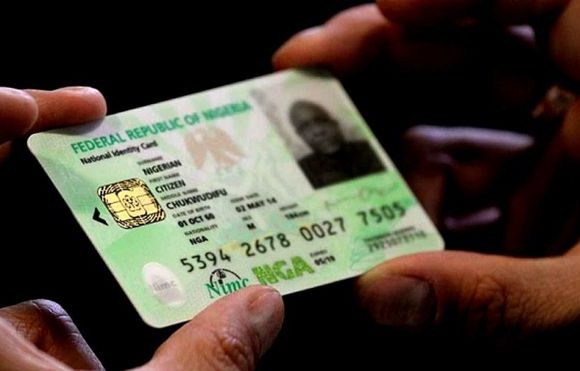
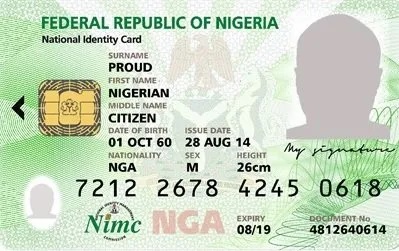
persons covered by the act are assigned a unique National Identification Number,
NIN, and issued General Multi-Purpose Cards, GMPC, to those who are citizens of
Nigeria, as well as others legally residing within the country.
According
to the acting Director-General of NIMC, Hadiza Dagabana, since its
establishment, only over thirty seven million Nigerians of the estimated two
hundred million population are registered despite the awareness on the
activities of the organization.
For
instance, the number of registered people is less than half of the eighty-four
million who registered for the 2019 general election despite the fact that
unlike the voters registration, the NIMC registration is not restricted to
people of eighteen years and above.
Recently,
the National Identity Management Commission, NIMC, announced that Nigerians
seeking to replace their lost National ID cards or renew existing ones are to
pay fees.
The NIMC
stated that Nigerians who lost their ID cards would pay five thousand naira to
replace them, while those whose cards expired would pay three thousand naira
for renewal.
The
requirements include a written application with attached proof of payment
receipt made through Remita, bank teller and NIN slip to be submitted at the
commission’s office.
Also,
the Joint Admissions and Matriculations Board, JAMB, had made it mandatory for
prospective candidates to collect NIMC’s card, which would place financial
burden on parents.
However,
Mrs. Dagabana said that the adoption of the National Identification Number, NIN,
as a criterion for all examinations in the country will tackle malpractices
such as impersonation.
She
stressed that registration for NIN has already started at the primary school
level of education across the country and should be encouraged to further
enhance confidence in the nation’s examination system.
According
to her, doing so will help to stop impersonation, adding that registration
processes for NIN should become mandatory before enrolment for public
examinations.
It is
alleged that the commission is not well funded by the government, hence, the
need to source funds for the making of the National Identity Cards.
Report
says that the payment for renewal of NIMC cards is capable of robbing over one
hundred million Nigerians of their right to possess their country’s ID card.
It is
stating the obvious that many Nigerians will be denied the access to the NIMC
card with the recent development.
Since
the core mandate of the commission is to register as many citizens as possible,
some stakeholders believe that the motive of its creation will be forfeited as
many citizens will be prevented from registering.
In a
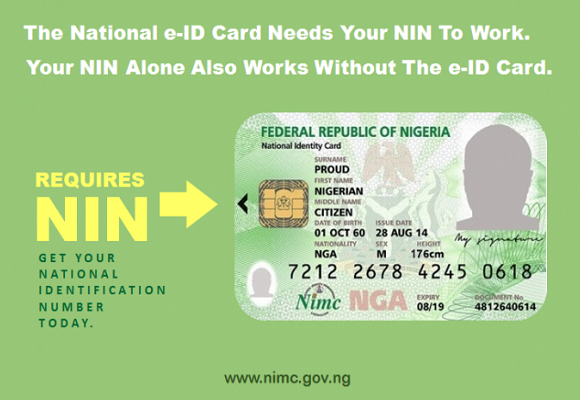
country where there is no unified central database, having the NIN without the ID
card itself might hamper citizens’ eligibility where the National ID card is
required.
Even if Nigerians
are to renew any other form of identification, the National ID card should
never be subject to renewal, especially if failure to renew can hamper citizens
in any way.
NIMC’s
failure to establish a National Identity Database is appalling and unacceptable.
NIMC is not and should not be a revenue
generating federal agency, but must provide the National ID card to all
citizens free of charge, therefore, these charges should be dropped.
Titilayo Kupoliyi