Foreign

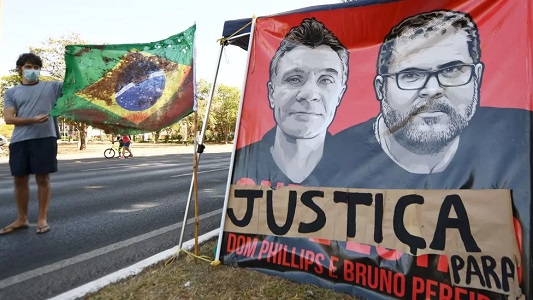
Police have indicted the former head of Brazil’s Indigenous protection agency for his alleged role in the murder of British journalist Dom Phillips.

Police didn’t identify the official, named as Marcelo Xavier by state media.

He was accused of “possible malice” for failing to act on information that police believe could have prevented Phillips’ death.

Phillips and Brazilian indigenist Bruno Pereira were killed on a reporting trip in the Amazon rainforest last year.

Three men have separately been charged with carrying out the double homicide.

Pereira was accompanying Phillips, a veteran journalist who wrote for newspapers including The Guardian and Washington Post, by boat through the Javari Valley near Brazil’s border with Peru as part of Phillips’ research for a book on conservation efforts in the Amazon.

The huge region is home to around 6,300 Indigenous people from more than 20 groups and is under threat from illegal loggers, miners and hunters.

The pair went missing on 5 June 2022 and their bodies were recovered 10 days later.

The latest development in the case saw federal police announce charges against the former president and former vice president of Brazil’s National Foundation for Indigenous Peoples (Funai) agency.

While authorities did not name the two officials, a number of media outlets including state broadcaster Agencia Brasil identified one ex-official as Mr Xavier.

They became aware at a meeting held in 2019, and through other documents, that the life of agency employees – such as Pereira – was at risk in lawless areas like the Javari Valley.

But they did not take the “necessary measures” to protect them, police said in a statement.

“In this way, they would have assumed the risk of the result of their omissions, which culminated in the double homicide,” the force added, appearing to suggest Mr Xavier’s failure to protect workers indirectly paved the way for the murders of Phillips, 57, and Pereira, 41.

Pereira had previously been employed by Funai but was not at the time of his death.

His and Phillips’ disappearance sparked a manhunt in the remote area of the rainforest, and a global outpouring of support for their safe return.

After their bodies were discovered and identified, police found the pair had been shot dead, burned and buried in the forest.

Three men were later charged with their murders – Amarildo Oliveira, his brother Oseney Oliveira and Jefferson Lima.

They are thought to have decided to kill the pair when Pereira asked Phillips to take a picture of their illegal fishing boat.

BBC/Simeon Ugbodovon

Subscribe to our Telegram and YouTube Channels also join our Whatsapp

News

Authorities in the Brazilian state of São Paulo say at least 36 people have been killed in heavy flooding and landslides, forcing some cities to cancel annual Carnival celebrations.

The video showed neighbourhoods under water, flooded motorways and debris left after houses were swept away, as rescue teams were been struggling to reach survivors and unblock roads.

More than 600mm, 23.6 inches, of rain, fell in some areas on Sunday, twice the expected amount for the month.

“Search and rescue teams are not managing to get to several places; it is a chaotic situation,” said Felipe Augusto, the mayor of the hard-hit town of São Sebastião.

“We have not yet gauged the scale of the damage. We are trying to rescue the victims.”

Dozens were missing in the town and about 50 houses had collapsed and washed away, Mr Augusto added, saying that the situation remained “extremely critical”.

The state government reported at least 35 deaths in São Sebastião and the mayor of Ubatuba, some 80km, 50 miles, north-east, said a young girl had been killed. Hundreds have been displaced and evacuated.

“Unfortunately, we are going to have many more deaths,” a civil defence official told the newspaper Folha de São Paulo.

Meanwhile, officials say another 228 people have been left homeless, with 338 more evacuated from coastal regions north of São Paulo.

A 180-day state of calamity was declared in six towns in the state: São Sebastião, Caraguatatuba, Ilhabela, Ubatuba, Guarujá and Bertioga.

State Governor Tarcísio de Freitas said he had released the equivalent of $1.5m, in funding to aid in disaster relief.

Carnival events were cancelled across the northern coastline, which is a popular destination for wealthy tourists looking to avoid huge street-side festivities in the big cities.

The festival usually lasts for five days in the run-up to the Christian festival of Lent and the colourful celebrations are synonymous with Brazil.

Latin America’s largest port in Santos was also shut as wind speeds exceeded 55km/h, and waves rose to over a metre, local media reported.

President Luiz Inácio Lula da Silva, who was spending the carnival weekend in the north-eastern state of Bahia, said he would visit the affected areas on Monday.

In a post on Twitter, he sent his condolences to those who had lost loved ones and promised to bring authorities together to provide healthcare and rescue teams.

“We are going to bring together all levels of government and, with the solidarity of society, treat the wounded, look for the missing, restore highways, power connections and telecommunications in the region,” Mr da Silva wrote.

More heavy rain is expected in the area, threatening to make conditions even worse for emergency teams.

Extreme weather events such as floods are expected to become more common as the impacts of climate change took hold.

Last year, torrential rain in the south-eastern city of Petropolis killed more than 230 people.

BBC/Taiwo Akinola                                  

Subscribe to our Telegram and YouTube Channels also join our Whatsapp Update Group

Politics

Brazil’s president, Luiz Inácio Lula da Silva, has sacked the country’s army chief, two weeks after rioting in the capital.

General Julio Cesar de Arruda had only been in the role since 30 December – just before former president Jair Bolsonaro’s mandate ended.

President Lula has said he suspects members of the armed forces colluded with protesters.

He has dismissed dozens of military officers in recent days.

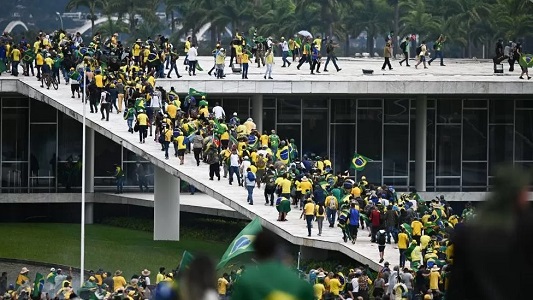
Thousands of supporters of Mr Bolsonaro stormed government buildings in Brasília on 8 January after managing to march, largely unchallenged, through the city.

Several police officers were injured in the violence and the presidential palace, Congress and Supreme Court were vandalised after rioters forced their way in. Some 2,000 people were detained on the day, Brazil’s federal police reported, and nearly 1,200 remain under arrest.

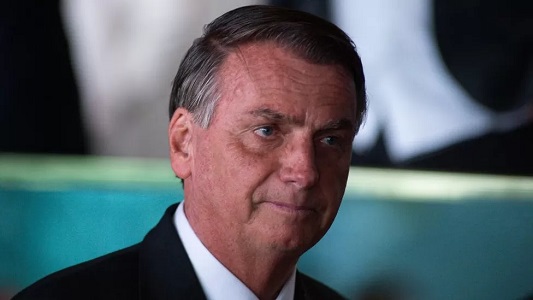
The Supreme Court is investigating what happened and is including Jair Bolsonaro in the probe. Prosecutors said the far-right former leader may have incited the riot after posting a video that questioned the legitimacy of last year’s presidential election.

He has denied any involvement in or responsibility for the uprising by his supporters.

General Arruda is being replaced by a military commander close to the president – General Tomás Ribeiro Paiva. He made a speech earlier this week urging soldiers to accept the result of the presidential election.

Unsubstantiated allegations of fraud in October’s election were a driving motivation for many Bolsonaro supporters involved in the storming. Many were also enraged that President Lula, who was found guilty of corruption in 2017 and spent time in prison before his convictions were annulled, was back in power.

President Lula blames Mr Bolsonaro directly for the rioting, but also points the finger very firmly at collusion by “people inside the armed forces”.

Mr Bolsonaro was previously an army captain and known to have the support of certain figures in the military. Lula’s sacking of the army commander and removal of dozens of officers responsible for presidential security could be seen as steps towards rebuilding trust in the military personnel who surround him.

After this tumultuous start, Lula now faces the challenge of trying to govern in a bitter and thoroughly polarised atmosphere.

On Friday, Brazil’s Defence Minister, José Múcio, said it was time to turn the page and focus on the country’s future – adding that the military as an institution was not involved in the rioting.

Meanwhile, Jair Bolsonaro remains in Florida, where he has been since he refused to attend President Lula’s inauguration ceremony.

Last week, the former justice minister and a key ally of Mr Bolsonaro, Anderson Torres, was arrested after being accused of “sabotaging” police efforts to protect the buildings in Brasília.

BBC/Simeon Ugbodovon

Subscribe to our Telegram and YouTubeChannels also join our Whatsapp Update Group

Foreign

Brazil’s Supreme Court has agreed to include right-wing former president Jair Bolsonaro in its investigation into the storming of government buildings in Brasília.

It is the first time that Mr Bolsonaro has been named among those potentially responsible for the 8 January riots.

It comes days after Mr Bolsonaro posted a video questioning the legitimacy of October’s presidential election.

Prosecutors said Mr Bolsonaro may have incited a crime by making such claims.

They asked the Supreme Court on Friday to include the ex-president in the investigation.

The Bolsonaro video claimed that President Luiz Inácio Lula da Silva was not voted into office but rather chosen by the Supreme Court and Brazil’s electoral authority.

By questioning the vote “Bolsonaro would have publicly incited the commission of a crime”, the office of the prosecutor general (PGR) said in a statement.

While the video was posted after Sunday’s riot and later deleted, the prosecutor general’s office argued its content was sufficient to justify investigating Mr Bolsonaro’s conduct beforehand.

Supreme Court Judge Alexandre de Moraes announced Mr Bolsonaro would be included in the probe into what the PGR said was the “instigation and intellectual authorship” of the rioting.

“Public figures who continue to cowardly conspire against democracy trying to establish a state of exception will be held accountable,” said Justice de Moraes.

Thousands of radical Bolsonaro supporters, who continue to claim that the election was rigged, stormed the country’s Supreme Court, Congress and presidential palace on Sunday.

They had been camping in and around the capital Brasilia for weeks calling for a military coup.

Meanwhile, Mr Bolsonaro has been admitted to a hospital in Florida with abdominal pain, his wife said.

He left Brazil for the United States in late December, after refusing to take part in the handover of power to Lula.

Many businessmen and officials are being investigated, including Brasilia’s former head of security, Anderson Torres, who flew to the US ahead of the riots.

On Thursday, police visited his home and found a document reportedly trying to reverse the election result.

Mr Torres argues the document has been taken out of context, but Justice Minister Flavio Dino has said he must turn himself in by Monday or face extradition.

Earlier, Lula accused Mr Bolsonaro’s allies of aiding an attack on the presidential palace on Sunday.

More than 1,200 people have been formally arrested and are being charged in relation to the riot at Brazil’s Congress.

Arrest warrants have already been issued for several top officials accused of being “responsible for acts and omissions” that led to the riots.

BBC/Simeon Ugbodovon

Subscribe to our Telegram and YouTube Channels also join our Whatsapp Update Group
Foreign

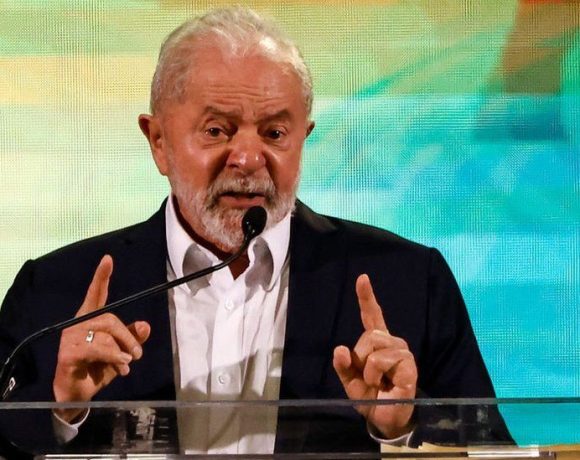
Luiz Inacio Lula da Silva has been sworn in as the new president of Brazil – the third time he has held the country’s highest office.

The veteran left-wing politician, known widely as Lula, also led the country between 2003 and 2010 – and defeated Jair Bolsonaro in October’s poll.

In his first speech, Lula vowed to rebuild a country in “terrible ruins”.

He decried the policies of his predecessor, who went to the US on Friday to avoid the handover ceremony.

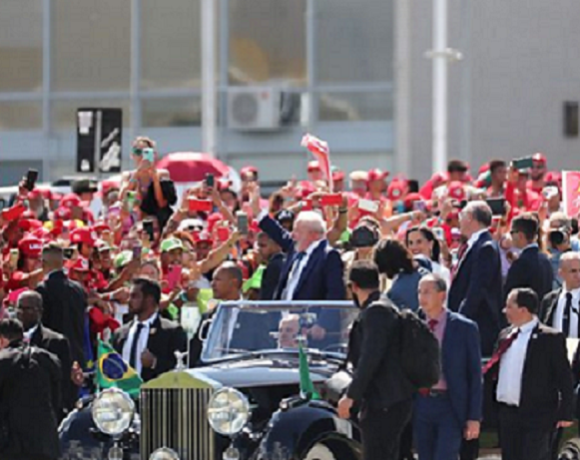
A sea of Lula supporters gathered in front of Congress since early in the morning – decked out in the red colour of his Workers’ Party. They travelled to see their leader sworn in – but also for a celebration.

More than 60 artists – including Samba legend Martinho da Vila – were booked to perform on two giant stages decorated in the national flag as part of a music festival dubbed “Lulapalooza”.

“Love has won over hate,” read one banner carried by a man dressed as Lula – complete with a presidential sash.

“Brazil needed this change, this transformation,” said another backer of the incoming leader as she queued for Sunday’s festivities.

Juliana Barreto – who is from Lula’s home state Pernambuco – told the BBC that her country was “a disaster” previously.

Lula and incoming Vice-President Geraldo Alckmin paraded through the city on an open-top convertible before proceeding to the Congress building – where the swearing-in occurred at the start of the formal inauguration ceremony.

The men have spent the past days selecting their cabinet and appointing supporters to key state-owned businesses.

Shortly after being sworn in, Lula sought to instil a sense of hope in the people of Brazil and promised to “rebuild the nation and make a Brazil of all, for all”.

There were several instances when he got out his hanky. His most emotional moment came when speaking to the Brazilian people after the swearing-in ceremony – he started sobbing when talking about those who beg at traffic lights, desperate for food.

Probably not even Lula thought this day would ever come – a return to the top job after two decades, despite a spell in prison after being convicted of corruption. The convictions were subsequently annulled in 2021.

Much of his speech to Congress was about unity and reconstruction. The two words are crucial in such a deeply divided country, hit hard by the pandemic and hugely polarised politically.

Lula knows that his ultimate challenge will be to convince those who feel he is a corrupt politician who belongs in jail that he does now belong in the presidential palace again and can be their leader too.

He pledged to undo the legacy of his predecessor’s government, which he said involved depleting funding for education, health and the conservation of the Amazon rainforest.

To huge cheers from those watching in Congress, he also promised to revoke Mr Bolsonaro’s controversial gun laws immediately.

Lula went on to state that his government would not be motivated by “a spirit of revenge”, but that those who had made mistakes would answer for their errors.

In particular, he singled out Mr Bolsonaro’s Covid-19 policies, accusing him of causing a “genocide” of deaths in Brazil during the pandemic, which would need to be fully investigated.

In another noted change of policy from the Bolsonaro administration, Marina Silva – one of Brazil’s best known climate activists – was re-appointed to head the environment and climate ministry. She will be expected to achieve Lula’s pledge – which was repeated during his speech – to reach “zero deforestation” in the Amazon by 2030.

The atmosphere in Brasilia couldn’t be more different than when Mr Bolsonaro was in power. Lots of people were waving banners or wearing T-shirts with the words “Love conquers hate,” a reference to the narrative many felt came from Mr Bolsonaro.

But diversity and inclusion too was a big part of today’s inauguration. With Mr Bolsonaro abandoning his final official duty of passing on the presidential sash, it was left to Eni Souza, a rubbish picker, to do the honours. And standing next to Lula was an indigenous leader, a black boy and a disabled influencer. In this country where racism is all too common, it was an important image that will endure.

The state of Brasilia deployed “100%” of its police force – around 8,000 officers – to the city amid fears that some supporters of Mr Bolsonaro could seek to disrupt proceedings.

One man was arrested trying to enter the area of the inauguration carrying a knife and fireworks earlier on Sunday, Brazil’s military police said.

Last week, authorities arrested a supporter of Mr Bolsonaro who had allegedly placed explosives on a fuel truck near an airport in the capital on Christmas Eve. The man said he hoped to “sow chaos” ahead of Lula’s inauguration.

And other supporters of the former leader have remained camped outside army headquarters, where they have been urging the army to launch a coup. Police attempted to remove the demonstrators on Thursday, but withdrew after they reacted violently.

However, Mr Bolsonaro has condemned the protests against his defeat, urging his supporters to “show we are different from the other side, that we respect the norms and the Constitution”.

BBC/Simeon Ugbodovon

Subscribe to our Telegram and YouTube Channels also join our Whatsapp Update Group
Foreign

Former Brazilian leader Luiz Inácio Lula da Silva has launched his campaign for October’s presidential election.

At a rally, the left-winger called on Brazilians to support him in defending the country’s democracy from the far-right President Jair Bolsonaro.

Lula led the country for eight years from 2003 but was later convicted of corruption and jailed before having the judgment overturned last year.

The rally was called a “pre-launch” as official campaigning begins in August.

Lula’s campaign pledges to “join democrats of all political positions, classes, races and religious beliefs”.

The 76-year-old told supporters that the current situation in the country “forces us to overcome our differences and build an alternative path to the incompetence and authoritarianism that governs us”.

“I’m jumping back into the fight,” he told a cheering crowd in São Paulo on Saturday.

Lula, who governed Brazil between 2003 and 2010, is a towering figure in left-wing politics in Brazil and beyond. His government helped lift tens of millions of people from poverty.

But in 2018 he was the most senior politician to be convicted as part of an investigation into a huge bribery scandal, known as “Operation Car Wash“.

After his conviction and 12-year jail sentence, Lula was banned from the presidential race in 2018.

But last year, a Supreme Court judge annulled his corruption convictions, ruling that a biased judge who looked at Lula’s case had compromised his right to a fair trial.

Earlier this year, Mr Bolsonaro said that Lula’s return to the presidency would be like “the return of a criminal to the crime scene”.

There are growing fears that, if Lula wins the October elections, Mr Bolsonaro might not accept defeat as he has repeatedly questioned Brazil’s electronic voting system.

Lula has picked the centrist former governor of São Paulo, Geraldo Alckmin as his running mate for vice-president. Mr Alckmin’s more moderate political stance is expected to attract voters who are unhappy with President Bolsonaro’s administration, but are also wary of Lula’s politics.

Mr Alckmin, who stood against Lula in the 2006 presidential elections, thanked Lula for his trust and said he is proud of their alliance.

Recent opinion polls show that Lula has a comfortable advantage over his rival.

President Bolsonaro has faced pressure from the public over his handling of the Covid-19 pandemic, but his popularity has increased after a boost in his government’s welfare spending.

BBC/Simeon Ugbodovon

Health

The Presidential Steering Committee on COVID-19 says, persons who have visited Brazil, India or Turkey within Fourteen (14) days preceding travel to Nigeria, shall be denied entry into Nigeria. 

This regulation, however, does not apply to passengers who transited through these countries.

Chairman of the committee and Secretary to the Government of the Federation (SGF) Mr. Boss Mustapha in a statement disclosed that, after due consideration, the validity period of pre-boarding COVID-19 PCR test for all Nigeria-bound passengers has been reduced from 96 hours to 72 hours and PCR test results older than 72 hours before departure shall not be accepted.

He adds that, any airline who fail to comply shall mandatorily pay a penalty of $3,500 (Three Thousand Five Hundred dollars) for each defaulting passenger and non-Nigerians will be denied entry and returned to the country of embarkation at cost to the Airline. 

While Nigerians and those with permanent resident permit shall undergo 7 days mandatory quarantine in a government approved facility at the point-of-entry city and at cost to the passenger. 

On false declaration, passenger(s) who provide false or misleading contact information will be liable to prosecution and person(s) who willfully disregard or refuse to comply with directions of Port-Health staff, security agencies or evade quarantine shall be prosecuted in accordance with the law.

Mr. Mustapha states that, the action is taken to continue to safeguard the health of the Nigerian population, as well as to minimise the risk of a surge in the number of COVID-19 cases in Nigeria.

He says, the Presidential Steering Committee carried out a risk assessment of countries with high incidence of cases and the assessment took into consideration the epidemiology of cases, prevalence of variants of concern and average passenger volume between Nigeria and each country amongst other indicators and of the countries assessed, this interim travel advisory applies to three (3) countries in the first instance, Brazil, India and Turkey.

Nosa Aituamen

Foreign

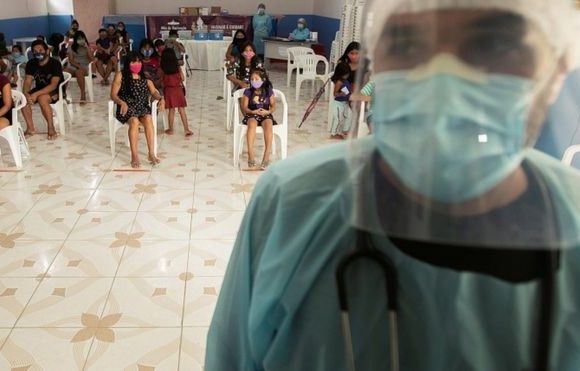
Brazil’s President Jair Bolsonaro has tested positive for coronavirus.

He took the test, his fourth, on Monday after developing symptoms, including a high temperature.

Mr Bolsonaro has repeatedly played down the risks posed by the virus, calling it “a little flu” and saying that he would not be seriously affected by it.

He has also urged regional governors to ease lockdowns, which he says hurt the economy, and on Monday he watered down regulations on wearing face masks.

Mr Bolsonaro made the announcement in a TV interview on Tuesday. He said the fever he had been experiencing had gone down and that he felt “very well”.

Back in April, he said that even if he were to be infected with the virus, he would “not have to worry as I wouldn’t feel anything, at most it would be like a little flu or a little cold”.

When he made the remark, the number of Covid-19-related deaths was still under 3,000 and the number of infections was around 40,000.

But the numbers have skyrocketed since then. As of Monday, the number of deaths was over 65,000 and infections were over 1.6m, second only to the United States.

Despite the rising numbers, President Bolsonaro has argued that regional lockdowns are having a more damaging effect than the virus itself, and accused the media of spreading panic and paranoia.

While he was at his most vocal and dismissive in March, he has continued to rail against measures that he deems “dictatorial” such as the closing beaches or requirements to wear face coverings.

On Monday, he made further changes to a law which would require Brazilians to wear masks in public.

He has attended a number of public events without a mask, even when local rules required him to wear one.

On Sunday, Foreign Minister Ernesto Araújo posted a photo on social media showing himself with President Bolsonaro and others attending an Independence Day celebration at the US embassy in Brasilia.

None of those in the photo is wearing a mask or observing social distancing.

BBC

Foreign

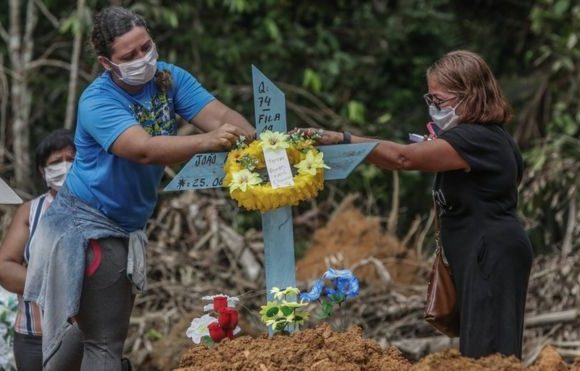
Brazil has become the second country, after the US, to register more than 50,000 deaths from Covid-19.

It comes amid growing political tension and just days after the country confirmed more than one million coronavirus infections.

Graphs of Brazil’s deaths and infections show a continuing climb.

The World Health Organization (WHO) has also recorded the biggest one-day increase in cases globally, with most of the new infections in the Americas.

The decision of Brazil’s far-right President Jair Bolsonaro to oppose lockdowns and focus on the economy has been hugely divisive.

Two health ministers both doctors have left their posts as deaths and infections have surged. The first was sacked by Mr Bolsonaro, the second resigned after disagreeing with the president.

bbc.com

Foreign

Brazil has become the second country in the world to confirm more than one million cases of Covid-19, as the disease continues to spread.

The health ministry also posted a record number of new cases in the past 24 hours – more than 54,000.

In addition, there were more than 1,200 deaths for the fourth consecutive day, taking the total to nearly 49,000.

A lack of testing suggests the true figures are higher and experts say the outbreak is weeks away from its peak.

The new figure was revealed hours after the World Health Organization (WHO) warned that the pandemic was entering a “new and dangerous” phase, with its director general Tedros Adhanom Ghebreyesus warning that cases were rising at the same time as people are growing weary of lockdowns and governments are seeking to restart their economies.

Latin America is among the areas currently seeing a spike in infections. There are major outbreaks in a number of countries, including Chile and Peru, while Mexico became the seventh country to officially surpass 20,000 virus-related deaths on Friday.

But only the US has seen more infections than Brazil, where far-right President Jair Bolsonaro has been heavily criticised for his response to the crisis. He has repeatedly clashed with state governors and mayors who have adopted strict restrictions to curb the spread of the virus, shutting down major cities.

Mr Bolsonaro argues that the economic impact of the measures will be much bigger than the virus itself, a position shared by many. But his overall approach to the crisis has led to the resignation of two doctors as health minister.

BBC

Sport

Brazil has withdrawn its bid to host the 2023 Women’s World Cup.

The Brazilian Football Confederation (CBF) said the government did not consider it wise to offer financial guarantees in the midst of the coronavirus pandemic.

Brazil will now support Colombia’s proposal, which is up against Japan and a joint bid from Australia and New Zealand to host the 32-team tournament.

FIFA will vote to select the hosts on 25 June.

“Because of the fiscal and economic austerity brought on by the Covid-19 pandemic, [the government] thought it would not be recommended to right now sign the guarantees asked for by Fifa,” said a CBF statement.

Brazil has hosted a number of major international sporting competitions in recent years, including the men’s World Cup in 2014, the 2016 Olympic and Paralympic Games and the Copa America in 2019. But the CBF felt it was an outsider to host yet another big event.

The country has been badly affected by the Covid-19 pandemic, with more than 35,000 deaths and in excess of 640,000 confirmed infections, but the latter number is believed to be much higher because of insufficient testing.

Adedayo Adelowo