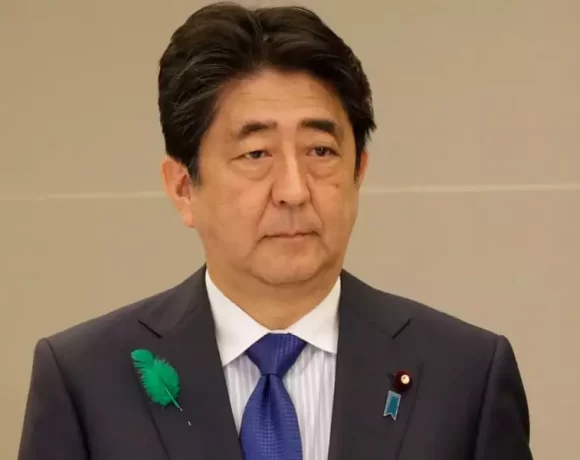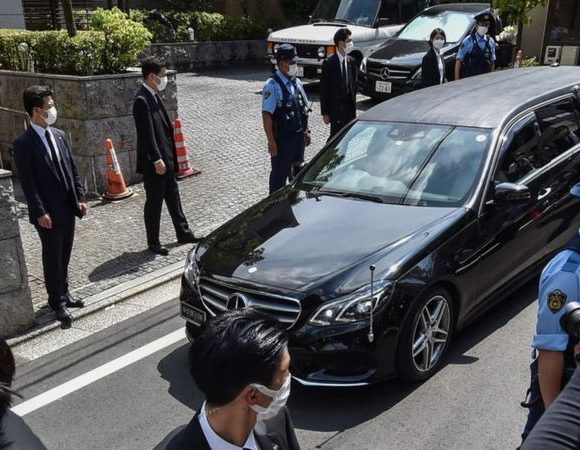
Japanese police have admitted there were flaws in the security for former Japanese Prime Minister Shinzo Abe, who was shot dead in the southern city of Nara on Friday.
“It is undeniable that there were problems in the security,” said Nara police chief Tomoaki Onizuka.
A gunman opened fire on Abe at a political campaign event – a crime that has profoundly shocked Japan.
Sunday’s elections for the upper house are going ahead as planned.
Voting began at 07:00 local time, 22:00GMT, just two days after Abe’s assassination.
Analysts suggest his killing could boost support for the governing Liberal Democratic Party, LDP , for which Abe was a leading and hugely influential figure.
Elections for Japan’s less-powerful upper house of parliament are typically seen as a referendum on the current government.
Campaigning continued on Saturday with tighter than usual security.
Police say the suspect, named as Tetsuya Yamagami, 41, held a grudge against a “specific organisation”.
Japanese media quote sources close to the investigation, who say Yamagami believed Abe to be linked to a religious group which, Yamagami alleged, had ruined his mother financially.
The suspect has admitted shooting Abe with a homemade gun, according to police.
“The urgent matter is for us to conduct a thorough investigation to clarify what happened,” police chief Onizuka said, without specifying where he saw failings. He was on the verge of tears, addressing journalists.
Yamagami told police he had served in Japan’s navy, the Maritime Self-Defense Force, for three years. More recently, he had worked at a factory in western Japan.
Abe was Japan’s longest-serving prime minister and died aged 67. He was campaigning for the LDP in the run-up to upper house parliamentary elections on Sunday.
Current Prime Minister Fumio Kishida, also an LDP member, said he was “simply speechless”, vowing that Japan’s democracy would “never yield to violence”.
He said the election campaign would continue on Saturday with tightened security, with Sunday’s vote still set to go ahead.
Gun violence is extremely rare in Japan, where handguns are banned and incidences of political violence are almost unheard of.
Police are investigating why Abe was targeted and whether his killer acted alone.
Abe was giving a speech on behalf of a political candidate at a road junction when he was shot from behind. Photos show the suspect standing close to Abe moments beforehand.
Witnesses described seeing a man carrying a large gun moving within a few metres of Abe and firing twice. The former prime minister fell to the ground as bystanders screamed in shock and disbelief.
BBC /Taiwo Akinola