Foreign

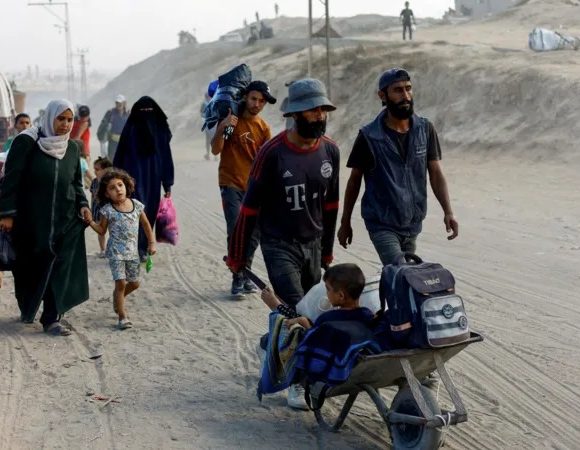
Thousands of Palestinians are continuing to flee Gaza City, a day after Israel said it had begun a major ground offensive aimed at occupying the city.

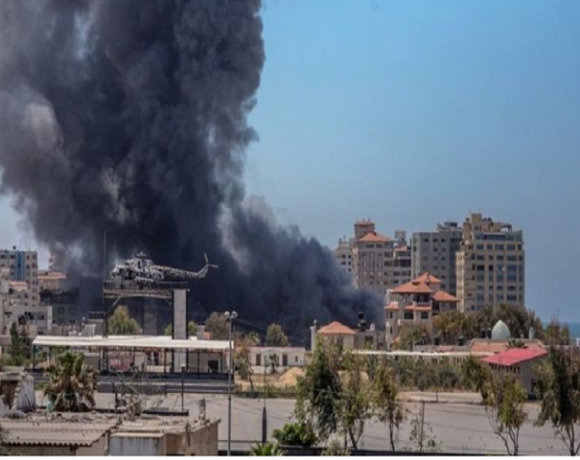
Amid large-scale bombing overnight, Gaza’s Hamas-run health ministry said al-Ranitisi children’s hospital was targeted in three separate attacks, forcing half of its patients and their families to flee.

The Israeli military said it was looking into the reports. Earlier, it announced that it had struck more than 150 “terror targets” across Gaza City in two days.

Israel says it aims to defeat up to 3,000 Hamas fighters in what it describes as the group’s “last stronghold” and free its hostages, But the offensive has drawn widespread international condemnation.

The heads of more than 20 aid agencies have called on world leaders to act, saying “the inhumanity of the situation in Gaza is unconscionable” and calling for “urgent intervention”.

For days, huge columns of Palestinians have streamed southwards from Gaza City in donkey carts, rickshaws, vehicles strapped high with belongings, and on foot.

Until now, they have been forced to flee down a single coastal road to an Israel-designated “humanitarian area” in al-Mawasi.

But on Wednesday, the Israel Defense Forces (IDF) announced that it would open a second route to leave, down the central Salah al-Din road. It said the route would be open for 48 hours from 12:00 local time (10:00 BST).

Many Palestinians say they are unable to move south due to the rising costs associated with the journey. Some say renting a small truck now costs around 3,000 shekels ($900; £660), while a tent for five people sells for about 4,000 shekels.

Lina al-Maghrebi, 32, a mother of three from the city’s Sheikh Radwan neighbourhood, told the BBC: “I was forced to sell my jewellery to cover the cost of displacement and a tent.”

“It took us 10 hours to reach Khan Younis, and we paid 3,500 shekels for the ride. The line of cars and trucks seemed endless.”

Aid groups, UN agencies and others say the “humanitarian area” they are expected to move to is heavily overcrowded and insufficient to support the roughly 2 million Palestinians who are expected to cram into it.

Some Palestinians who followed the military’s orders to evacuate to the zone say they found no space to pitch their tents and so returned north.

But US Secretary of State Marco Rubio appeared to offer tacit support for Israel’s operation during a joint press conference with Netanyahu on Monday.

He said the US preferred a negotiated end to the war, but that “sometimes when you’re dealing with a group of savages like Hamas, that’s not possible”.

At least 64,964 people have been killed by Israel during its campaign since then, almost half of them women and children, according to Gaza’s health ministry.

BBC/Adebukola Aluko

Subscribe to our Telegram and YouTube Channels, and also join our WhatsApp Update Group.

Foreign

US Secretary of State Antony Blinken says Palestinians must not be pressured into leaving Gaza, and must be allowed to return to their homes on terms and conditions.

Report says, Mr Blinken condemned statements by some Israeli ministers, who called for the resettlement of Palestinians elsewhere.

The US official was in Qatar on his latest Middle East tour.

His comments come following reports that dozens of people were killed at a refugee camp in northern Gaza.

Footage from Jabalia shows bodies lying in the rubble of a destroyed building – many of them women and children.

The Israeli military has not yet responded to the reports.

More than 60 Palestinians have reportedly also been killed in the past day in the southern city of Khan Younis.

The Jabalia camp has been hit several times since Israel began its war against Hamas following the unprecedented attack by Hamas gunmen on southern Israel on 7 October.

Some 1,200 people were killed – most of them civilians – and about 240 others taken hostage in the Hamas raids.

More than 22,000 people – mostly women and children – have been killed in Gaza, according to the Hamas-run health ministry. It has reported at least 113 deaths over 24 hours of Israeli bombardment.

“Palestinian civilians must be able to return home as soon as conditions allow,” Mr Blinken said on Sunday. “They cannot, they must not be pressed to leave Gaza.”

Israel’s far-right Finance Minister Bezalel Smotrich has called for Palestinians to leave Gaza and make way for Israelis who could “make the desert bloom”.

And National Security Minister Itamar Ben-Gvir this week issued a call “to encourage the migration of Gaza residents” as a “solution” to the crisis.

The official line from the Israeli government is that Gazans will eventually be able to return to their homes, though it is yet to outline how or when this will be possible.

Meanwhile, the situation in Gaza continues to deteriorate. Health officials said even medical facilities including hospitals are now unsafe.

Three international medical aid groups announced they were pulling out of the Al-Aqsa Hospital in central Gaza after Israel issued evacuation orders.

A representative of the United Nation’s Office for the Coordination of Humanitarian Affairs (OCHA), told the BBC World Service’s Newshour programme that they were “hugely concerned by this development”.

“What it means is that a hospital that was already over-crowded and overloaded and well beyond its capacity is now without absolutely critical reinforcement to support it as it deals with an ever-increasing number of casualties,” said Gemma Connell.

The head of the World Health Organization, Tedros Adhanom Ghebreyesus, said that, more than 600 patients and health workers were forced to leave the hospital, according to its director.

“Their locations are not currently known,” said Mr Tedros in a post on X, formerly known as Twitter.

Mr Blinken’s latest trip to the Middle East comes amid rising tensions in the region, with concerns that the war in Gaza could spread.

Saleh al-Arouri, a top Hamas official, was assassinated in a suspected Israeli attack in southern Beirut on Tuesday along with six others – two Hamas military commanders and four other members.

Hassan Nasrallah, the leader of Hezbollah, the powerful Iranian-backed movement in Lebanon, described Arouri’s assassination as a “flagrant Israeli aggression” that would not go unpunished.

Hezbollah then fired rockets into Israel on Saturday as a “preliminary response” to the killing of Arouri.

BBC/Taiwo Akinola

Foreign

The European Union is to release hundreds of millions of euros in aid to the Palestinians.

Months of delays had contributed to what the Palestinian Authority said was its worst financial crisis.

The hold-up was caused by concerns that Palestinian textbooks glorified violence and promoted anti-Semitism.

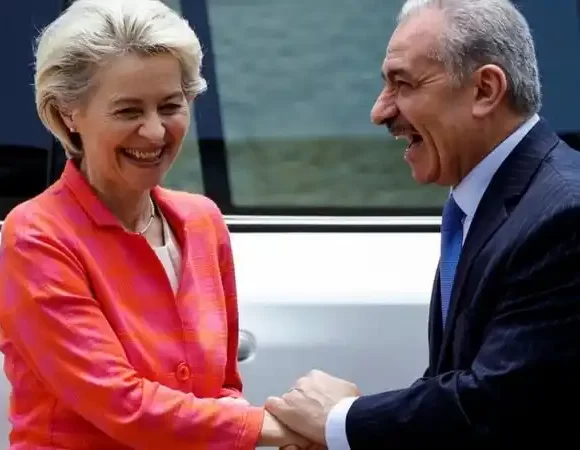
European Commission President Ursula von der Leyen announced that 2021 funds could be “disbursed rapidly” after she met Palestinian Authority officials.

“All the difficulties are gone,” she told a news conference in Ramallah, in the occupied West Bank, without mentioning whether she had asked for any changes to the textbooks

Palestinian Prime Minister Mohammed Shtayyeh thanked Europe for resuming the funding, which he said came “without conditions”.

The Palestinian Authority, which governs parts of the West Bank, is propped up by donor money.

The EU, along with European states and other institutions, have together been its biggest backer, giving about €600m ($627m; £519m) a year.

But since 2020 a large portion of the EU’s funding – valued at about €215m – has not been handed over because of officials’ concerns over Palestinian textbooks.

The European Commissioner for Neighbourhood and Enlargement, Olivér Várhelyi, said last July that the assistance should be conditional on the PA ensuring that all educational materials adhered fully to Unesco standards of peace, tolerance, coexistence and non-violence.

The funding crisis has left the PA unable to pay full salaries for teachers, firefighters and doctors, and has prevented some Palestinians from getting essential medical care.

Ms von der Leyen said the EU was working to support the Palestinian people, especially the most vulnerable, and that it would mobilise €25m to improve food security in the Palestinian territories, which are heavily dependent on imports of cereals from war-torn Ukraine.

Earlier on Tuesday, she promised in a speech at a university in southern Israel to put “the fight against anti-Semitism and fostering Jewish life in Europe at the core of the European Commission’s agenda”.

“Anti-Semitism has not disappeared. It still poisons our societies. And anti-Semitic attacks happen today in Europe. It is a new threat, but it is the same old evil. Every new generation must take responsibility so that the past does not return,” she said.

She also said the EU wanted to step up energy co-operation with Israel in response to Russia’s use of fossil fuels to “blackmail us” over Ukraine.

BBC/Simeon Ugbodovon

News

Violence in Gaza and Israel shows no sign of abating amid continued rocket fire and air strikes, and civil unrest among Jewish and Israeli Arab mobs.

Deaths continue to mount, with at least 83 people now killed in Gaza and seven in Israel.

A BBC reporter in Gaza said it had been the “longest and most difficult night since the 2014 war”. Israel said it had been targeted with 1,600 rockets.

Israel is now mulling a possible ground operation in Gaza.

It has sent reinforcements to the border.

This is now the worst violence since 2014, fuelled initially by weeks of Israeli-Palestinian tension in East Jerusalem which led to clashes at a holy site revered by both Muslims and Jews. This spiralled into an incessant exchange of Palestinian rocket fire and Israeli airstrikes.

The fear among civilians on both sides is taking its toll.

Najwa Sheikh-Ahmad, a Gaza mother, said of Wednesday night: “You cannot sleep… In any moment your home might be your grave.

“You cannot be secure. As a mother it’s very terrifying, it’s very exhausting for my feelings, for my humanity,” she told the BBC’s Today programme.

In Israel, an apartment block was destroyed in the city of Petah Tikva shortly after residents had gone to their bomb shelters.

“We heard an alarm and suddenly there was a bang. Smoke entered the shelter, and the neighbour next to me who was sitting on a chair flew back,” one resident told the news website Ynet.

Mohammed Abu Rayya, a doctor living in Gaza told the BBC: “[There are] a lot of deaths, a lot of wounded – children, old women and old men. We cannot sleep at home, we are not feeling safe. Air strikes all over Gaza. There are not any places safe.”

Authorities in Gaza, which is controlled by the Islamist militant group Hamas, say many civilians have died, including 17 children.

Israel says dozens of those killed in Gaza were militants, and that some of the deaths are from misfired rockets from Gaza.

The Israel Defense Forces (IDF) said they had struck Hamas targets more than 600 times. They said they had targeted homes and businesses used by militants and a school Hamas was using “to hide a terror tunnel”.

In the Israeli city of Sderot, a young boy was killed when rocket fire from Gaza hit his home, and shrapnel penetrated the shelter he was hiding in.

The escalating conflict has prompted international airlines, including KLM, British Airways and Virgin Atlantic, to suspend services to Israel.

Earlier on Thursday, incoming flights were diverted south from Tel Aviv’s main Ben Gurion airport to Ramon airport amid a flurry of rocket launches.

BBC