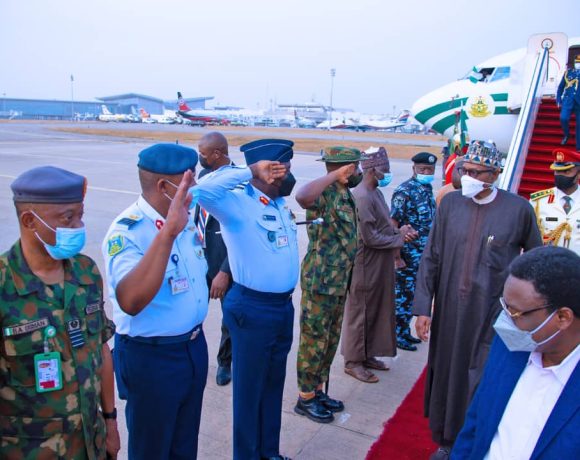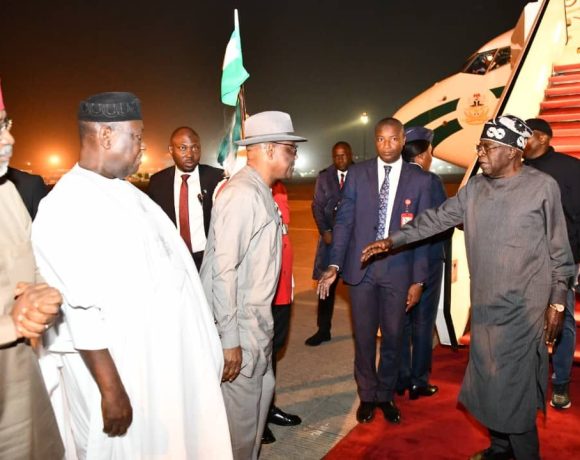
President Bola Tinubu on Tuesday night, returned to Nigeria after a two-week private visit to Paris, France.
The presidential jet, NAF 001, touched down at the Presidential Wing of the Nnamdi Azikiwe International Airport, Abuja at about 9 pm.
The President was received by top government officials, including his Chief of Staff, Femi Gbajabiamila; Secretary to the Government of the Federation, George Akume; National Security Adviser, Nuhu Ribadu and the Minister of the Federal Capital Territory, Nyesom Wike.
Also on the receiving line were the Kaduna State Governor, Uba Sani; Minister of State for Petroleum Resources, Heineken Lokpobiri; and the Director-General of the Department of State Service, Yusuf Bichi, among others.
Although the presidency remained silent on the reason for the visit, the Nigerian leader was billed to return “in the first week of February 2024,” a statement announcing his departure on January 24 noted.
The trip was Tinubu’s third to France and his 14th foreign visit since he assumed office eight months ago.
He returns amid protests in some states over the rising food and living costs.
On Monday through Tuesday, some angry youths and women took to the streets of Minna, the Niger State capital and Kano to protest what they described as the rising cost of living in the country. Similar protests also erupted in Ondo State, Nigeria’s South-West.
On Tuesday, the Minister of Information and National Orientation, Muhammed Idris, said Tinubu had directed immediate interventions to alleviate the suffering and forestall a further breakdown in security.
The minister spoke after a meeting of the Special Presidential Committee on Emergency Food Intervention, chaired by the President’s Chief of Staff, Femi Gbajabiamila, at the Aso Rock Villa, Abuja.
After Tuesday’s meeting, which is the first of a series of three, Mohammed told journalists, “It is a special presidential committee to address the issue of food shortage or lack of enough food on the table of most Nigerians.
“What I will tell Nigerians is that the President has directed that government needs to step in to stem this tide. The government will not fold its arms and see how Nigerians are suffering regarding the availability of these food items.
“So, I want to plead with you to understand with the government. By the time these meetings are concluded, we’ll be able to issue a definite statement on the government’s position in this regard. But all I can say is that discussions are ongoing, and very soon, a solution is in sight for Nigerians.”
Idris, who argued that Nigeria was in no shortage of food, said the Federal Government was in talks with millers and major commodity traders to avail more supply, thereby reducing the price of some commodities.
He also alleged that some elements were taking advantage of the high food prices and the depreciation of the naira to wreak havoc.
“The government is also talking to major millers and major commodity traders, also to see what is available in their stores, to open it up so the government will provide some intervention, discuss with them, provide some intervention to make this food available to Nigerians.
“What the government is noticing is that there is still food in this country. Some people are taking advantage of the situation, especially because of the depreciation in the value of our currency, which has led to the cost of these food items also going up.
“So, all these issues were discussed…the National Security Adviser was there because this also has some national security implications. All these have been discussed,” the minister explained.
Punch/Taiwo Akinola
Subscribe to our Telegram and YouTube Channels and also join our Whatsapp Update Group